
Alaska Deed Records
Alaska deed records are public documents maintained by the Alaska Department of Natural Resources Recorder's Office across 34 recording districts statewide. You can search deeds, mortgages, liens, and other land documents by name, date, or document type through the DNR's online index, which covers records from 1970 to the present. For older documents or certified copies, you can visit the Anchorage or Fairbanks recording office directly. Each district serves a specific region of the state, and most searches can be done online at no cost.
Alaska Deed Records Overview
How Alaska Deed Recording Works
The Alaska DNR Recorder's Office is the central authority for deed records in the state. It oversees 34 recording districts that record, index, and archive all documents that form the Official Public Record of the State of Alaska. About 1,000 new documents are recorded and added to the record each day. Millions of documents have been captured in the official records since before statehood, and that number keeps growing.
When a deed or other property document is presented for recording, the office reviews it to make sure it meets minimum acceptance criteria. Staff then collect the recording fees, assign identifying numbers including a date, time, and serial number, and add the grantor and grantee names plus the legal description to the statewide database exactly as they appear on the document. The document is then imaged and microfilmed. Once quality control checks pass, the digital image is released for viewing on the internet. The recording process page explains each step in detail.
Once a document is in the official record, anyone can view or get a copy of it. All records are public. From the time a deed is recorded in the district where the land sits, it serves as constructive notice to all later buyers and lenders. That is why recording promptly matters so much. An unrecorded deed can be void against a buyer in good faith who records first.
The DNR keeps one original roll of microfilm at the Archive Unit in Anchorage. A second roll goes to State Archives in Juneau for permanent storage. Both paper and electronic access paths exist so that records are never lost if one system has issues.
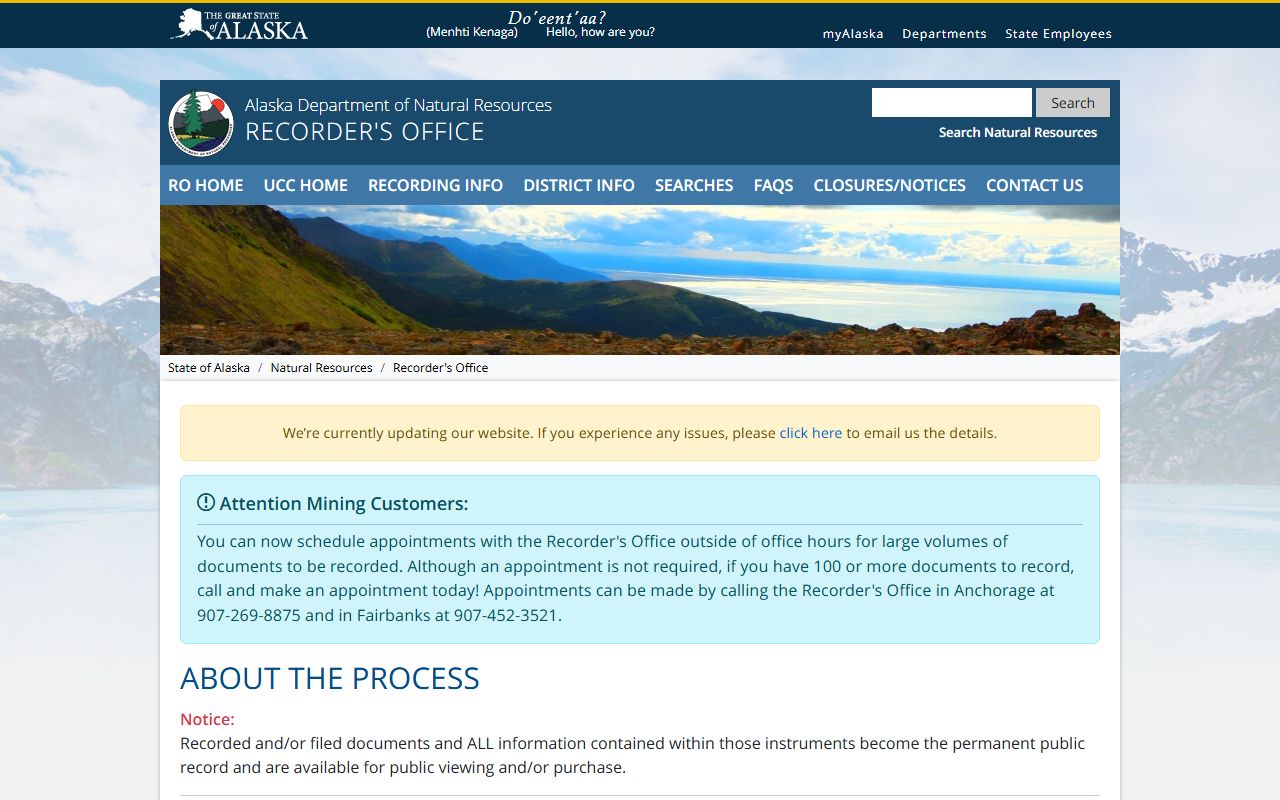
The DNR's about page walks through each stage of how deed documents move from submission to the public record.
Where Deeds Are Recorded in Alaska
Alaska has two physical recording offices that together serve all 34 districts. The Anchorage office is located at 550 West 7th Ave., Suite 108, Anchorage, AK 99501-3564 and can be reached at (907) 269-8876. It serves 22 recording districts including Aleutian Islands, Anchorage, Bristol Bay, Chitina, Cordova, Haines, Homer, Iliamna, Juneau, Kenai, Ketchikan, Kodiak, Kvichak, Palmer, Petersburg, Seldovia, Seward, Sitka, Skagway, Talkeetna, Valdez, and Wrangell.
The Fairbanks office is at 3700 Airport Way, Fairbanks, AK 99709-4699 and can be reached at (907) 452-3521. It handles 12 districts including Barrow, Bethel, Cape Nome, Fairbanks, Ft. Gibbon, Kotzebue, Kuskokwim, Manley Hot Springs, Mt. McKinley, Nenana, Nulato, and Rampart.
There is also a UCC Central File office at 550 West 7th Ave., Suite 108A in Anchorage, phone (907) 269-8873. That office keeps a statewide library and index of all UCC transactions filed to create a security interest in personal property. The State Recorder is Chrissi Thurman at (907) 269-8882.
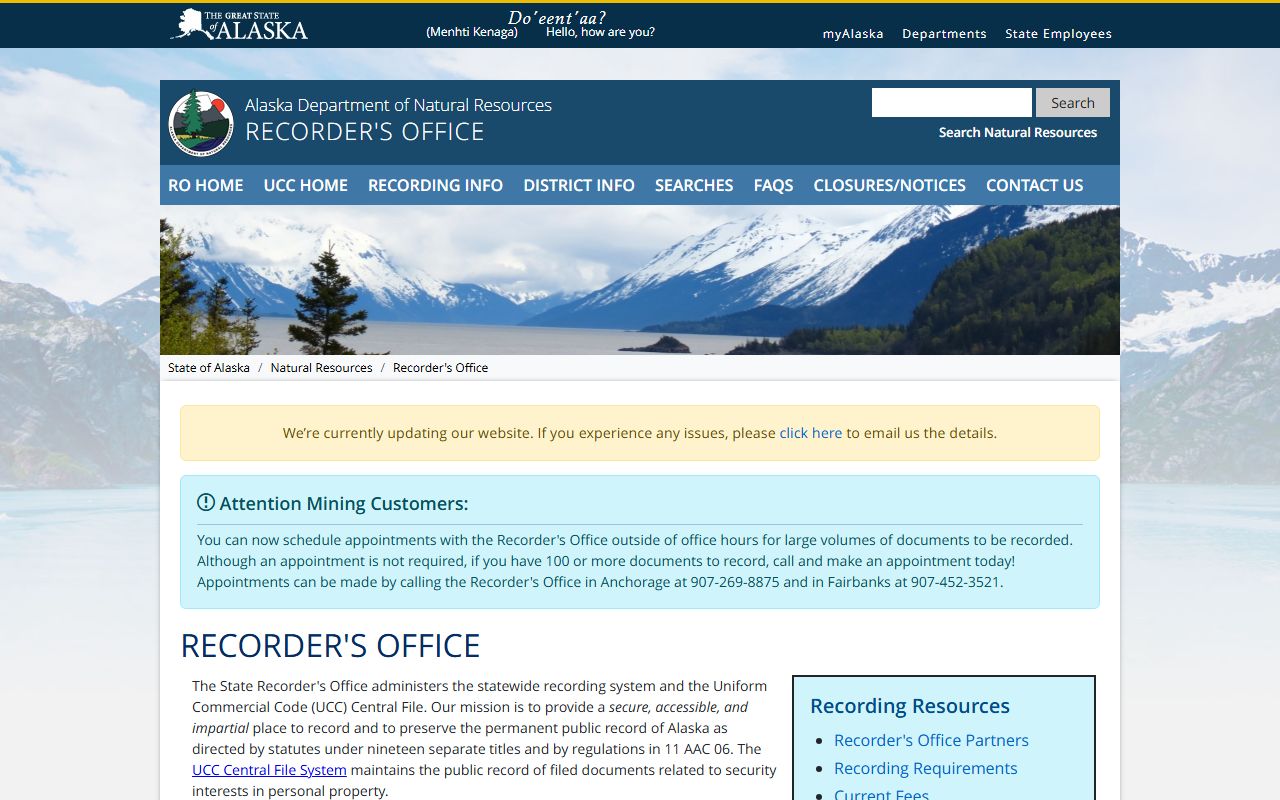
The DNR Recorder's Office main page is the starting point for searching deed records, finding district contacts, and learning about current recording requirements.
Note: If you are not sure which recording district your property falls under, check the full recording districts list on the DNR website before submitting documents or requesting copies.
How to Search Alaska Deed Records Online
The DNR maintains a statewide recording system database that is available through any DNR recording office or over the internet. The system uses a Grantor/Grantee alphabetical index and a location index by legal description. Both reflect documents recorded from 1970 to the present. You can search by name, date, document type, district, or the entire state at once. A variety of search options are available so you can narrow results quickly.
For records before 1970, searching requires use of Historic Books. These older records are not in the online system and must be reviewed in person at a recording office. Staff can help point you to the right book, but due to staffing limits and liability concerns, they are not able to do in-depth research on your behalf. That part is up to you.
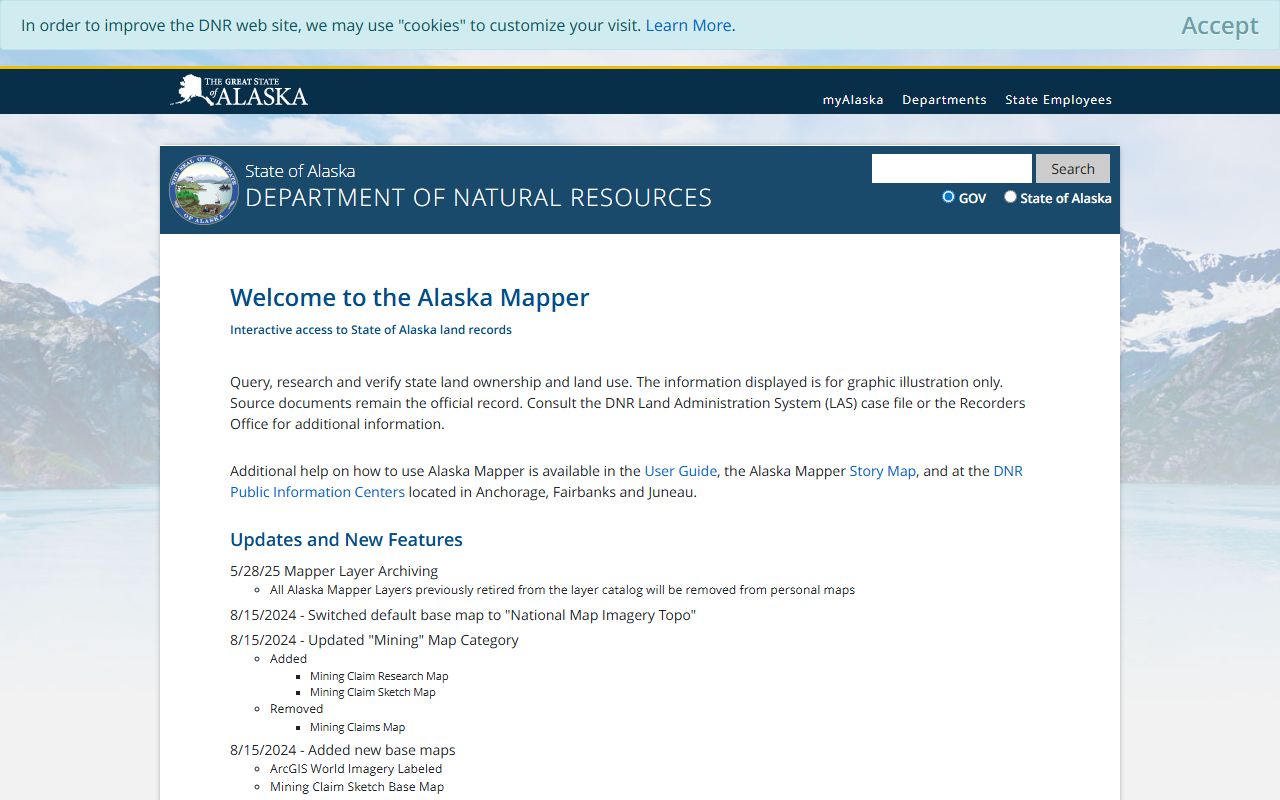
The DNR FAQ page covers common questions about searching the index, what documents are recorded, and how the public record system works.
For property and land boundary research, Alaska Mapper offers an interactive GIS tool. You can query, research, and verify state land ownership and land use through a map interface. The tool is useful for understanding parcel boundaries and identifying the correct recording district. Keep in mind that the information displayed is for graphic illustration only. Source documents at the Recorder's Office remain the official record.
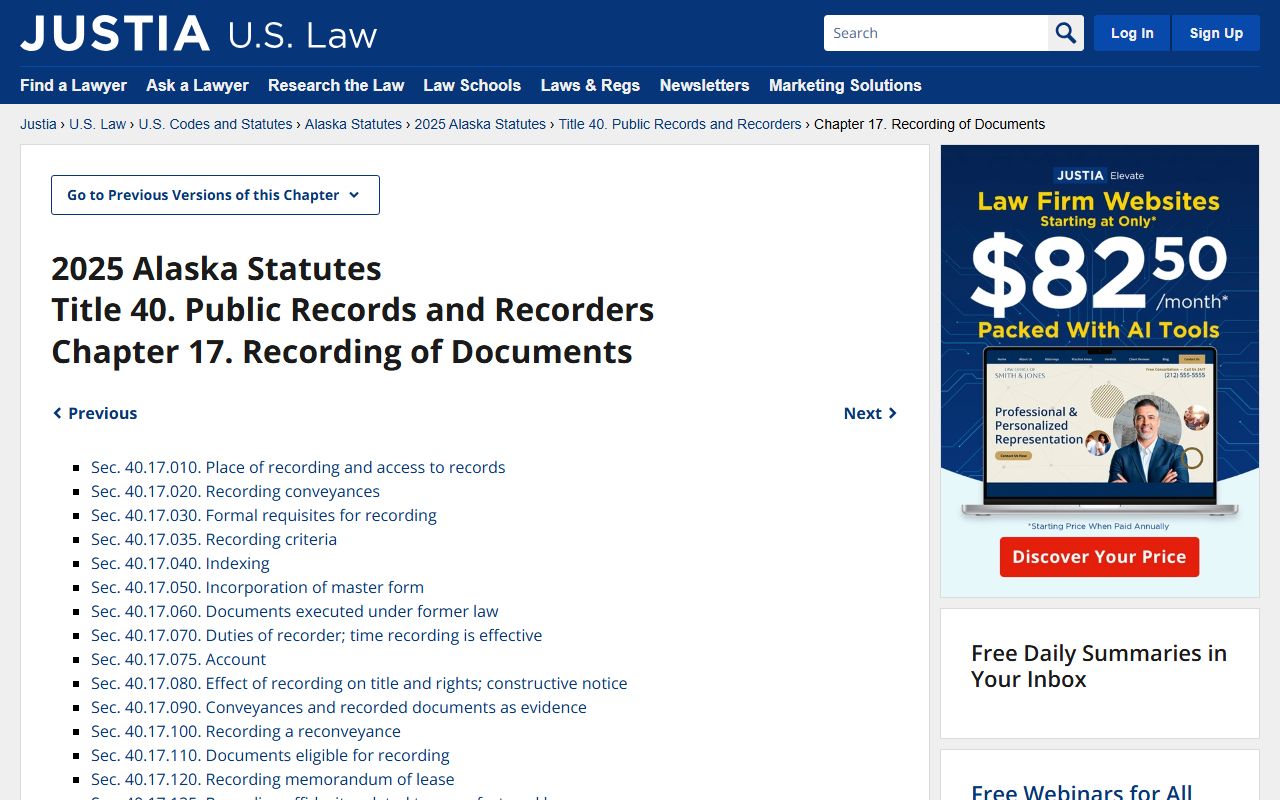
Alaska Mapper lets you view state land ownership, parcel lines, and land use designations on an interactive map tied to the official DNR records system.
Document Requirements for Recording
Per AS 40.17.030, documents must be submitted on opaque white paper no larger than 8.5 by 14 inches. The first page must have a two-inch top margin. All other margins on every side of every page must be at least one inch. Text must be at least 10-point font with consistent clarity so the imaging camera can capture a strong contrast between the text and the background.
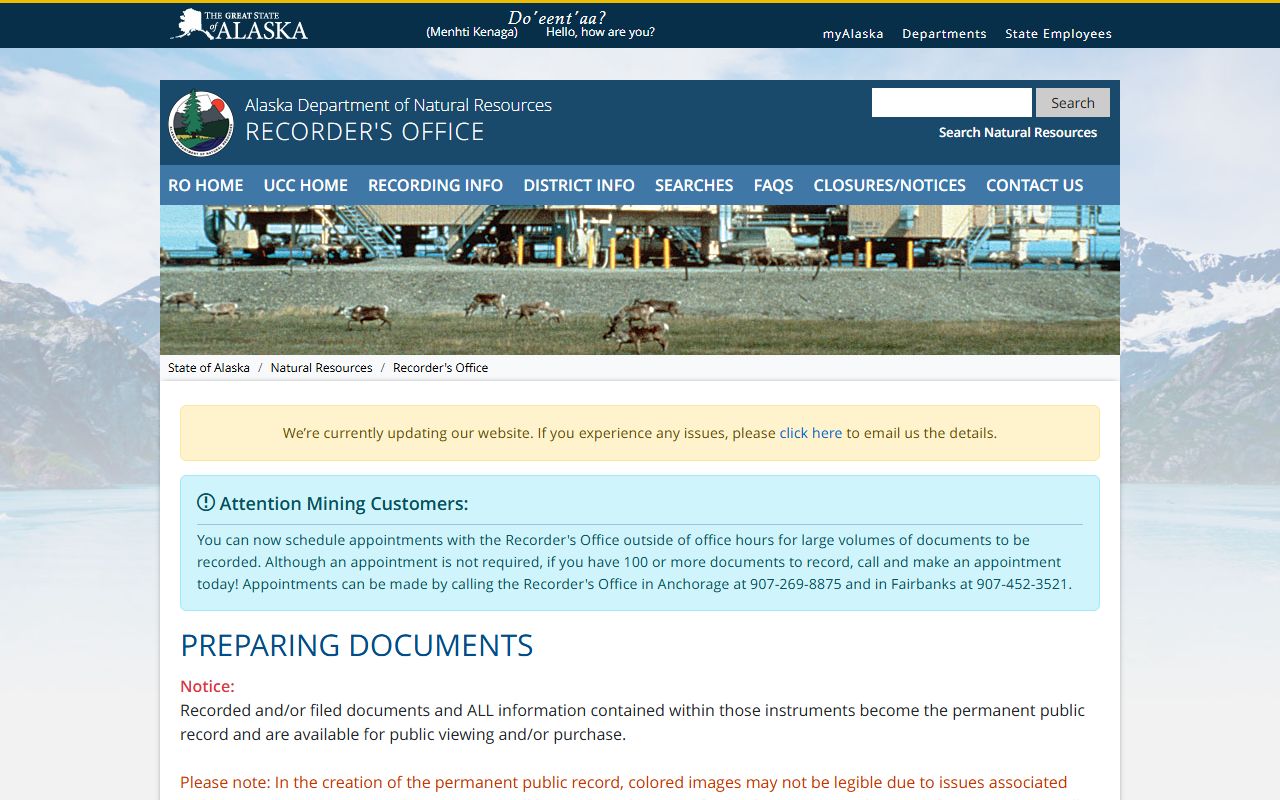
The DNR document preparation page lists all margin, paper, font, and formatting requirements that documents must meet before they can be accepted for recording.
Every deed must have a title that reflects its overall intent. The document must include the names of all grantors and grantees, a legal description of the property, the recording district where the property sits, a return address for mailing the recorded document back, and original signatures from all grantors. Spouse signatures are required when the property is a co-owned homestead. All indexing information must be in English.
If a document does not meet margin requirements, it can still be recorded as a non-standard document for an extra $50.00 fee paid on top of the regular recording fee. Taping, gluing, or stapling a page onto a larger one to meet margins is not acceptable. Two-hole punches at the top of any page also trigger the non-standard fee. These margin and font rules do not apply to UCC fixture documents, plats, or certified copies from government agencies.
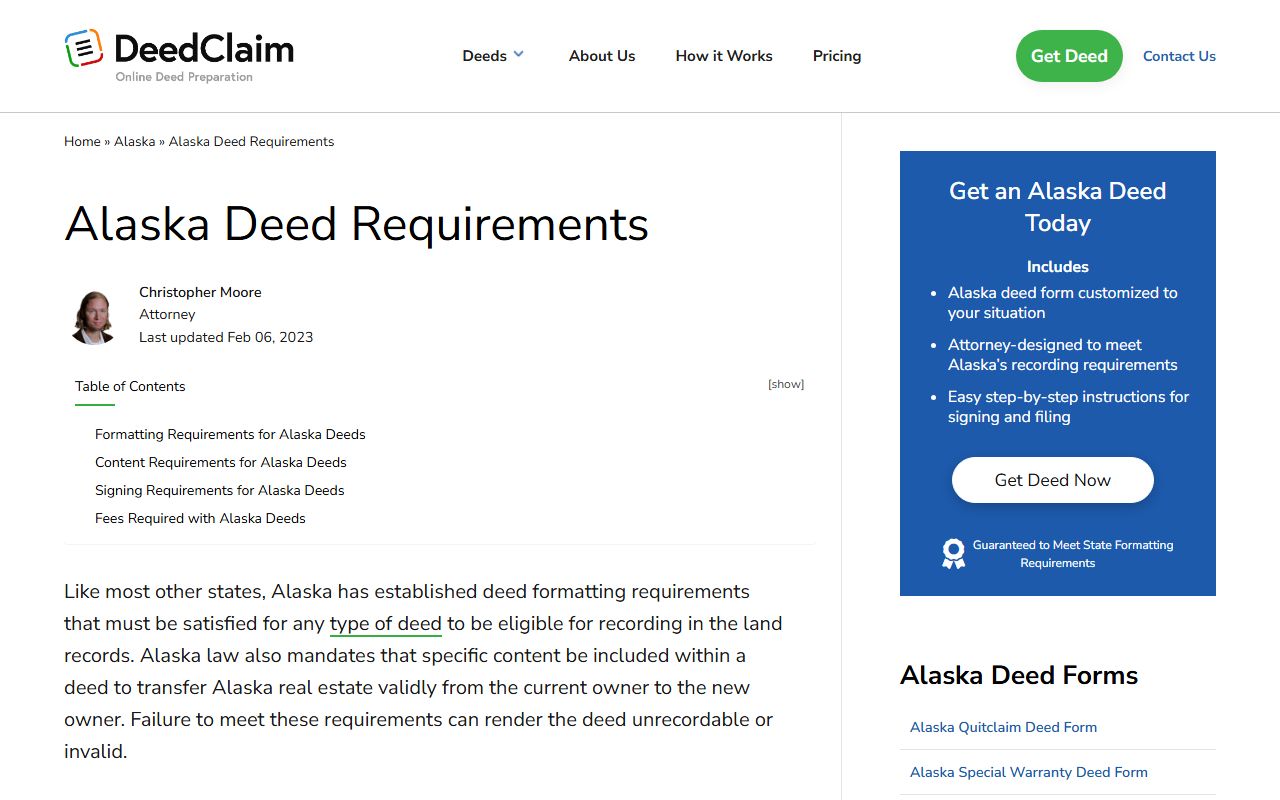
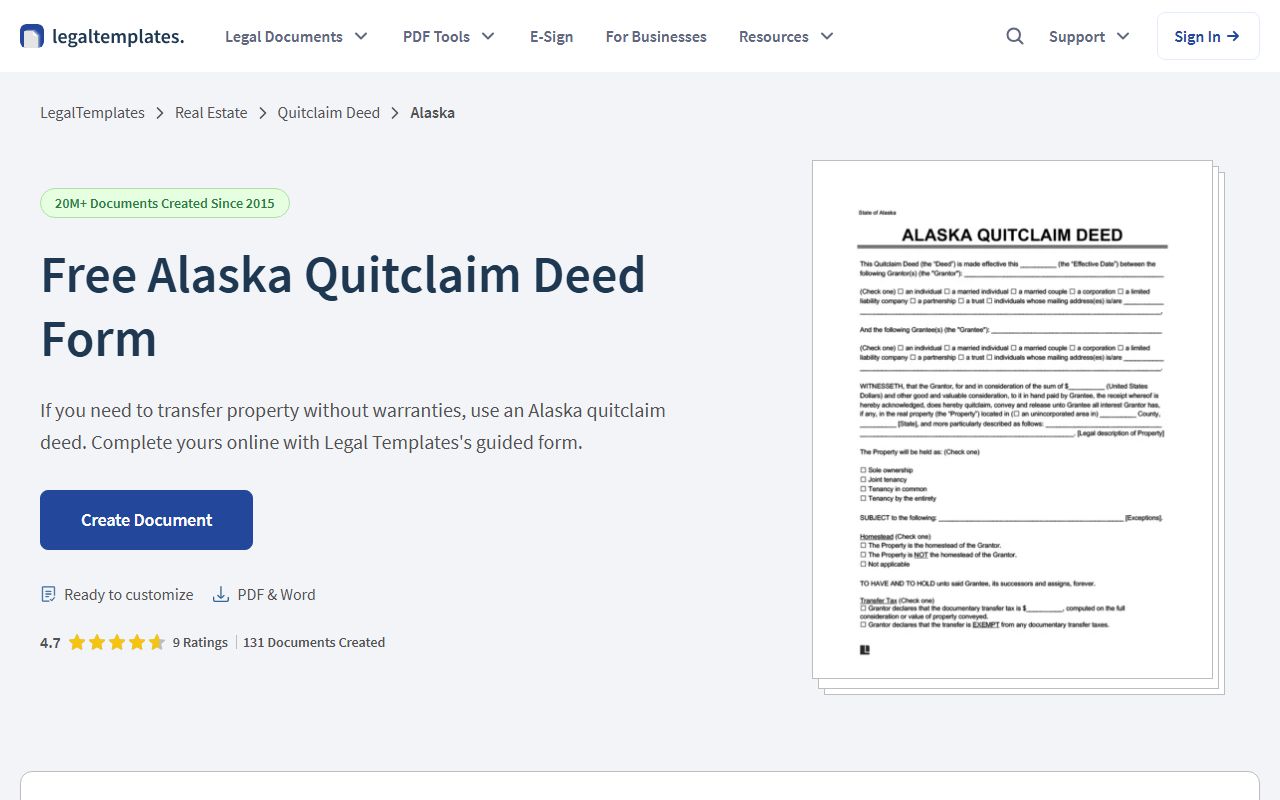
This Alaska deed requirements guide covers formatting, content, and signature rules for deeds in plain language, including specifics on quitclaim and warranty deed forms.
Alaska Recording Fees
Recording fees in Alaska are set by AS 40.17.030(a)(10) and 11 AAC 05.200. The fee to record the first page of any document is $20.00. Each additional page of the same instrument costs $5.00. When a document has more than six names to index, each name over six adds $2.00 to the fee. The non-standard document fee is $50.00 and is charged when a document does not meet the margin or paper requirements described above.
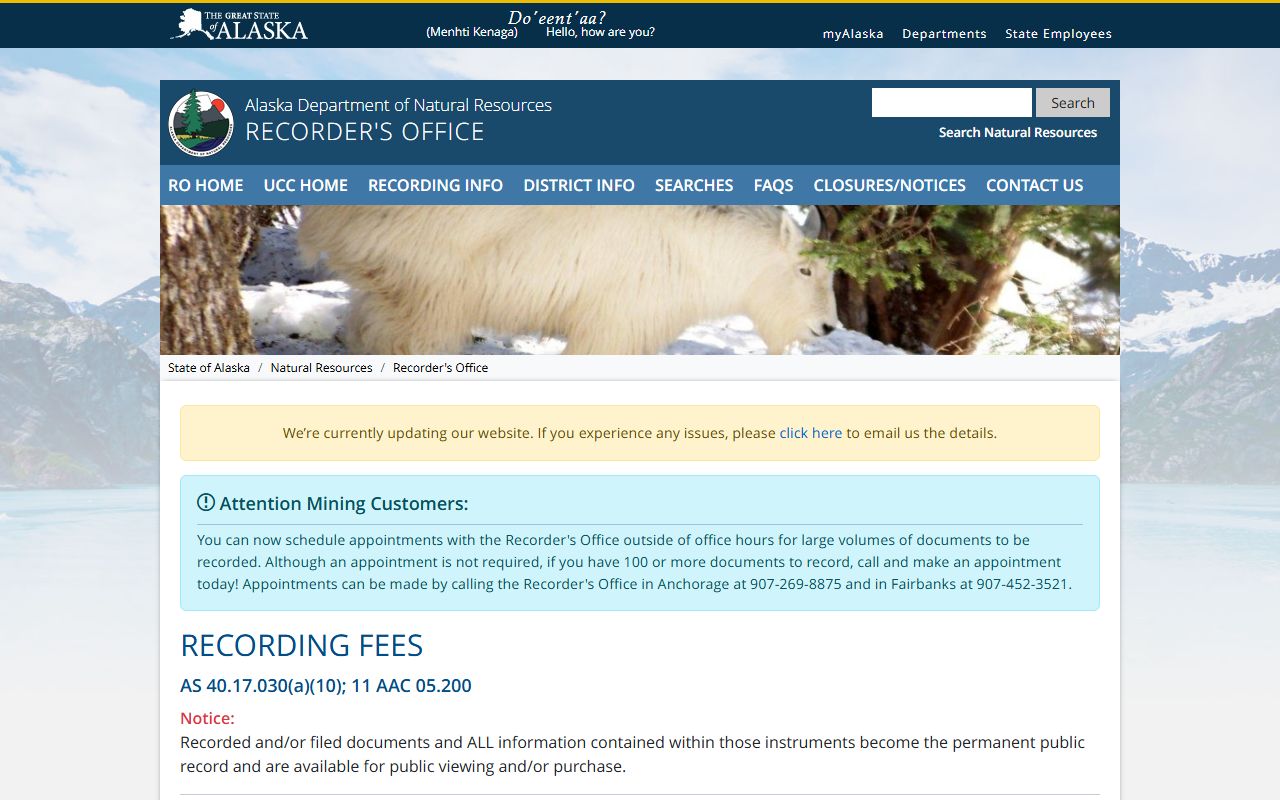
The DNR fee schedule page lists all current recording, copy, and certification fees in a clear table format.
Certification of a recorded document costs $5.00 per document. Photocopies of documents cost $1.25 for the first page and $0.25 for each additional page of the same instrument. Plat copies on paper run $5.00 per sheet full scale. Plat copies on mylar cost $12.00 per sheet. At the time of recording, a conformed copy is available for $2.00. Alaska does not charge a real estate transfer tax on deed recording.
Fees apply to all recording districts statewide. Make checks payable to the Department of Natural Resources when submitting documents by mail or in person.
Note: Images of documents on CD-ROM are also available. Contact the recording office directly for current availability and pricing on that option.
E-Recording in Alaska
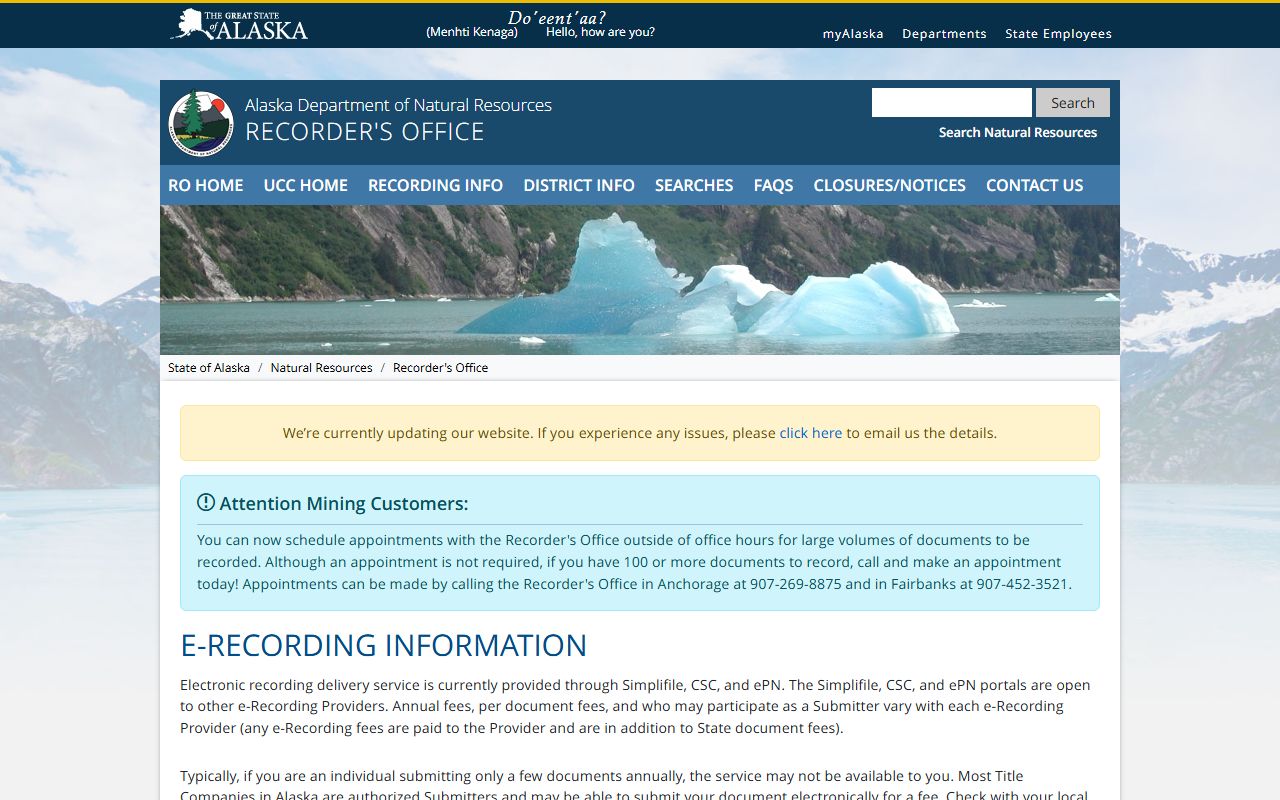
Electronic recording delivery in Alaska is available through three authorized providers: Simplifile, CSC, and ePN. The DNR e-recording page has contact details for all three. Annual fees, per-document fees, and submitter eligibility rules vary by provider. Any e-recording fees are paid directly to the provider and are in addition to the standard state document recording fees.
Most title companies in Alaska are authorized submitters through one or more of these services. If you are an individual who only needs to record a few documents per year, direct access to an e-recording portal may not be available to you. Check with your local title company to see if they can submit your document electronically on your behalf for a fee. This is the most common path for individual property owners who want to avoid mailing original documents.
Simplifile can be reached at (800) 460-5657, CSC eRecording at (866) 652-0111, and ePN at (818) 294-3694.
Types of Documents Recorded in Alaska
The DNR Recorder's Office accepts and records a wide range of property-related documents. Deeds are the most common, but the official record holds much more than that. Mortgages, assignments, modifications, reconveyances, and releases are all part of the record. So are liens of many kinds including notice of liens, claim of liens, and release of liens. Federal and state tax liens, child support enforcement liens, and UCC Uniform Commercial Code financing statements and security agreements are also recorded here. Judgments and decrees from courts complete the picture of who has what claim on a piece of property.
The office will also accept last wills and testaments, birth certificates, military discharge papers (DD-214), death certificates, and marriage licenses if they meet minimum acceptance criteria. However, those documents are not the standard records kept here. They go into the public record if submitted, but you should file those records with the appropriate agency for their normal purpose.
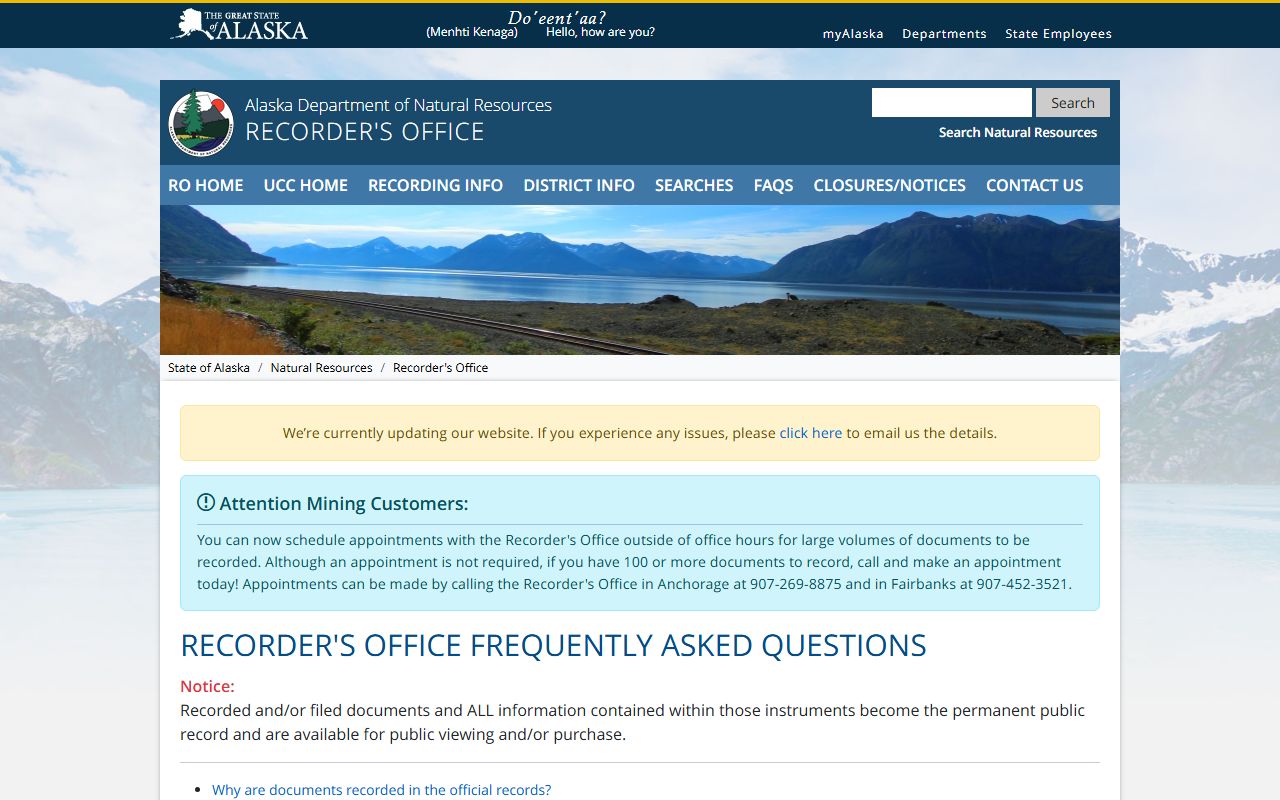
The DNR FAQ page includes a list of the document types accepted by the Recorder's Office and explains the purpose of recording each one.
Alaska Native Land Records and BIA LTRO
For land owned by Alaska Natives or held in Indian trust, a separate federal office handles the official record of title. The Bureau of Indian Affairs Alaska Region Land Titles and Records Office (LTRO) is the official federal office of record for all documents affecting title to Indian lands in Alaska. This includes determination, maintenance, and certified reporting of land title ownership and encumbrances on Indian trust and restricted lands.
All title documents affecting Alaska Native and Indian land must be recorded with the BIA Alaska Region LTRO rather than the DNR Recorder's Office. This includes patents, deeds, probate orders, leases, rights-of-ways, cadastral surveys, plats, subdivisions, and other Alaska Native and Indian land title documents. The LTRO also provides certified Title Status Reports that state the full status of title ownership and encumbrances for federal Alaska Native and Indian trust and restricted lands. For questions about Native land title documents, call the Alaska Region at (907) 271-4593.
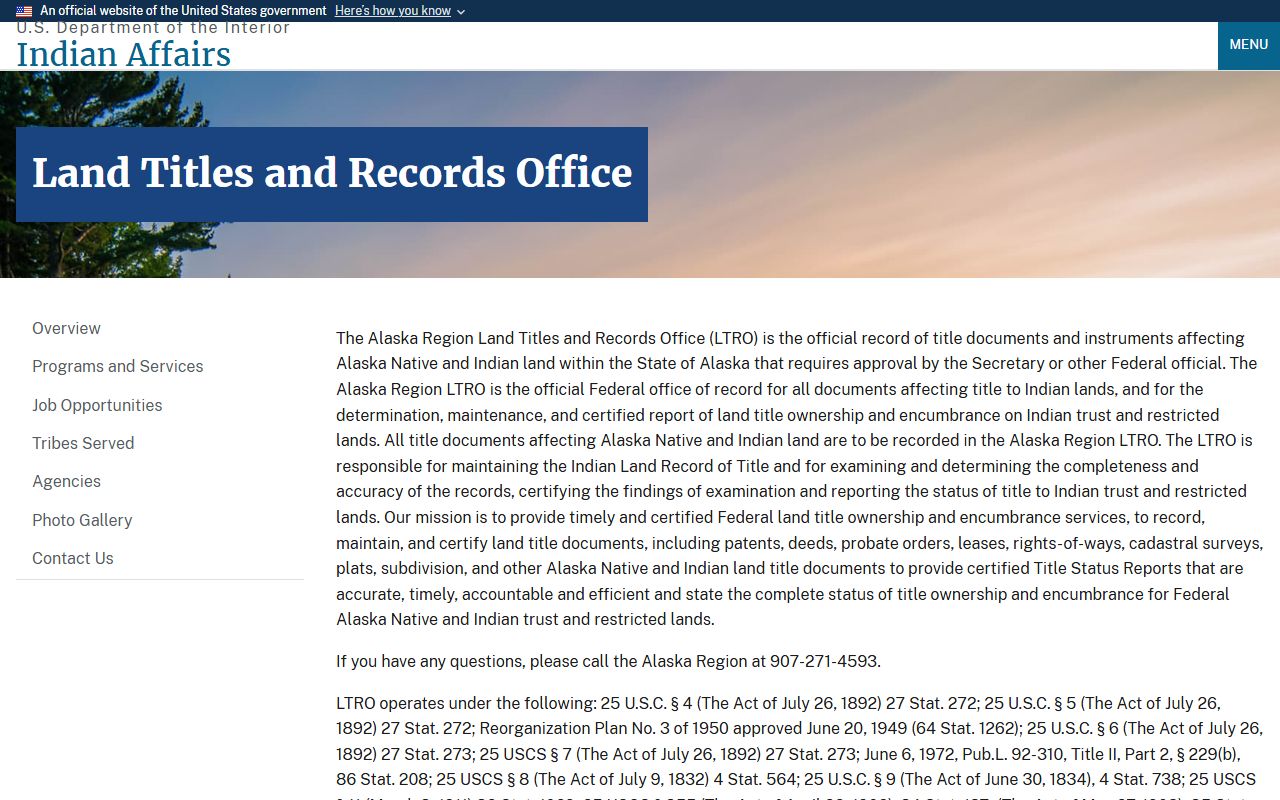
The BIA Alaska LTRO page explains what types of Native land title documents are recorded federally and how to request certified reports on trust land ownership.
Alaska Recording Laws and Statutes
Alaska Statutes Title 40, Chapter 17 is the primary law governing deed recording in Alaska. AS 40.17.030 sets out the formal requirements a document must meet to be eligible for recording. Those include original signatures, legible text, correct margins, an English-language title, complete mailing addresses for all parties granting or acquiring an interest, and the correct recording fee.
The full text of AS 40.17 on Justia covers every requirement for recording documents, from formatting rules to the legal effect of recorded and unrecorded conveyances.
AS 40.17.110 requires that conveyances of real property be acknowledged or proved in the manner set by law before they can be recorded. A notary or other authorized officer must witness the grantor's signature. AS 40.17.150 establishes the race-notice rule: an unrecorded conveyance is void against a subsequent buyer in good faith whose conveyance is first recorded. This is the key legal reason to record a deed right after closing rather than waiting.
Alaska does not charge a real estate transfer tax. There is no state-level documentary stamp tax applied when a deed changes hands. The only costs are the recording fees set under AS 40.17.030(a)(10) and the optional non-standard document fee if the document does not meet formatting requirements.
Property Fraud Prevention in Alaska
Deed fraud and seller impersonation fraud are real concerns for property owners. If you think your property may have been fraudulently recorded or transferred without your knowledge, the first step is to search the DNR Recorder's Office database by your name and by the legal description of your property. The search menu on the DNR site offers multiple options including name search, date search, document number search, and document type search. This lets you see every recorded document tied to your property.
If you find something suspicious, report it to the United States Internet Crime Complaint Center (IC3), your local law enforcement agency, and the Alaska Attorney General's Office. You should also talk to a real estate attorney. For a list of attorneys who handle real estate transaction law in Alaska, visit alaskabar.org. The American Land Title Association also has resources on seller impersonation fraud available at alta.org.
The DNR Recorder's Office provides a property fraud prevention guide that explains the warning signs of deed fraud and the steps to take if you believe fraud has occurred.
The recording districts list on the DNR site shows which office serves your area and includes contact details for both the Anchorage and Fairbanks offices.
Browse Alaska Deed Records by Location
Alaska deed records are organized by recording district. Most recording districts correspond to a borough or census area. Select a borough or census area below to find local deed record resources, office contacts, and search tools for that area.
Alaska Boroughs and Census Areas
All Alaska boroughs and census areas file deeds through the DNR Recorder's Office. The district that serves your area depends on where the property is located.
View All 30 Alaska Boroughs and Census Areas →
Deed Records in Major Alaska Cities
Residents of major Alaska cities record deeds through the DNR district that covers their area. Select a city below for deed record resources specific to that location.